

How Many Amps Draw On Blower Motor 2002 Mercury Sable Draw
The heater not blowing is no joke, I lived and worked as a mechanic in Canada for a time and nix could have prepared me for the winters. A good working motorcar heater isn't a luxury, information technology's critical to staying alive.
Top 4 reasons car heater blower stops working:
- Heater blower fuse blown
- Failed blower motor
- Faulty blower motor resistor
- Failed blower motor relay
In this post we'll comprehend all the common causes the blower motor fails to work, you'll larn how to diagnose your fault and how to gear up it.
ane Heater Blower Fuse Blown

A diddled fuse is by far the easiest item to check and that's why information technology's first on the list. Fuses normally accident for good reason, while it is true that colder weather tin cause greater amp draw which can cause fuses to blow, it is more common for the fuse to blow because of an underlying result.
Modern cars behave a ton of electrical consumers who all need a fuse, the point is your vehicle will have a ton of fuses in two or more fuse boxes located inside and nether the hood.

A quick google of your make and model will identify the fuse box location and fuse number, alternatively wait in the driver'due south manual under the fuses department. Most models will list the fuses on the rear of the fuse panel cover which is super helpful, I wish they all did it that way.
How to cheque the blower motor fuse?
With the fuse box located and the blower, motor fuse identified, go ahead and remove it and check the filament. If it's cleaved, the fuse is blown. Replacing the fuse may solve the problem or you may find it blows once again either immediately or before long thereafter.
The blower motor pulls quite a bit of power when working, most 35 amps, the fuse will likely be a large amperage 40A or so. Fuses are color-coded with the fuse size besides embossed into the casing.

A common crusade of fuse failure is fitting a fuse that's too minor for the job. It is important to replace the fuse with a correct amperage, likewise minor and the fuse volition accident over again and as well large could cause a burn risk.
If indeed your fuse is blown and you supersede it only to find it blows once again, you may have a blower motor brake (cheque for tree fall in the fan blades) or a short in the wiring, or more probable a faulty blower motor. More than on faulty blower motors later.
Subsequently checking the fuse, an auto technician would achieve for a lawmaking reader and bank check the car's climate control module (calculator) for error codes. This turbocharger the whole diagnostic process, if yous have i at present's the time to plug it in. Yous can check out my favorite bidirectional tool on the Auto electrical repair tools folio.
Equally almost don't accept a scan tool, I volition continue to diagnose this with just the aid of simple tools.
2 Failed Blower Motor

Blower motors work hard and failure is mutual. A slow first, intermittent operation or squeak noises are all early signs the blower motor is failing.
Some common causes of failure include, blocked windshield cowl drains cause rainwater to access the heater assembly, and damage the motor windings. Fan brake is another common crusade of motor failure. The blower motor sucks air from outside the cabin through the cabin filter. If the filter is missing or damaged debris such as tree fall can restrict blower movement.
The blower motor is commonly located rider side forepart nether the nuance panel. Access may be a pain in the jacksie, lay on your back with your head in the passenger footwell. Some cars are easy, yous look under the nuance, and there it is. Others, usually higher-stop models will require several panels and mayhap glove box removal.
How to test the blower motor?
Testing the motor is a simple procedure. We will need a voltmeter or bones test low-cal. The blower motor is located passenger side forepart nether the dash panel. With the ignition and fan speed ready to high, first, try the wiggle test, wiggle the wire to eliminate a bad connection.
Assuming the wiggle examination didn't work, get ahead and remove the ii-pin blower motor connector. I wire is power and the other is ground. Check both with the exam low-cal (move test light crocodile clip to power, to test basis side). When testing with a voltmeter, it should read 12 volts.

3 readings are common:
- Power and footing exam good (1 and 2 above) – Blower motor has failed, go alee and supplant the motor.
- Footing side is missing – Cheque the resistor/blower controller (come across beneath).
- Power side is missing – Bank check the resistor and fan relay for mistake (come across beneath).
Encounter the Auto electric repair tools page for a voltmeter, test lite, and other helpful diagnostic tools.
3 Failed Blower Motor Resistor
The heater blower motor resistor is a small controller that's employed to reduce the speed of the blower fan as per requests from the commuter. The resistor reduces the voltage supply to the blower motor which slows fan speed. Mod cars utilise a blower motor controller, which is a resistor by some other name.
Resistors work difficult reducing voltage, they are therefore a mutual cause of blower motor faults. Resistors, depending on the blueprint and how they fail either cease the fan from operating or cause the fan to merely operate at full speed no affair the fan speed request.
The resistor is unremarkably mounted to the fan housing close to the blower motor fan. Equally the resistor reduces voltage, it produces estrus as a by-production. To dissipate the heat, resistors use a heatsink (cooling fins) and utilize the absurd air from the fan speed to help cool the resistor.
How to exam the blower motor resistor?
Nosotros will need a voltmeter or basic test light. The resistor is located as said on the blower motor housing, and the blower motor housing is commonly located rider side front under the dash console.

Resistors unremarkably use four or five wires, a power input, a ground input, a control signal input from the heater control panel via the heater control module, and a variable basis output to the blower motor.
The variable ground output is what controls fan speed (some may also supply power to the motor). Note your wiring may be different, but the general working principle is the same.
Checking the resistor is similar any other controller, check power and footing, signal inputs, and outputs.
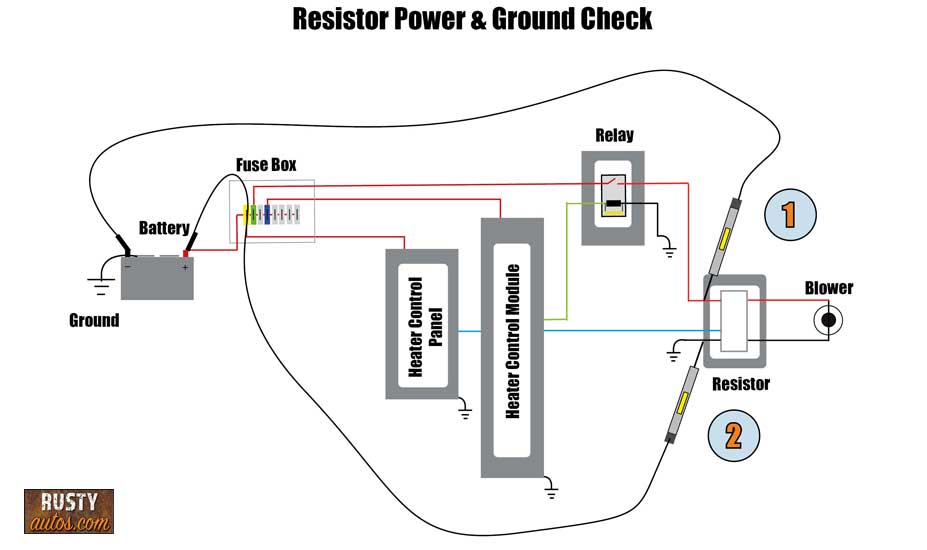
- Check resistor power and basis inputs (1 & 2 above) – With ignition on and fan turned to full, remove the blower motor resistor connector. Four wires are common, check ground and ability inputs. If power is missing, cheque the blower motor relay (see below).
- Bank check resistor output – With ignition and blower motor on and examination light crocodile clip on a expert power, probe the basis while turning the blower motor command on the command console. The test light should vary from bright to dim etc. If it doesn't, go ahead and check resistor input.
- Cheque resistor signal input – With the resistor unplugged apply a multimeter to check voltage between the power input and the point input while varying the blower motor speed. Voltage should vary also, if information technology does become ahead and replace the resistor, it's faulty. If the voltage doesn't vary, it is likely your command panel, climate control module or wiring betwixt them is at fault.


4 Faulty Blower Motor Relay

Relays are employed to safely command a higher amp circuit such every bit the blower motor using a depression amp circuit such equally a heater control console. Relays are small electromagnetic units that are commonly located inside the fuse box. Relays are generally durable and that's why they are last on theis list of items to cheque.
Almost relays are four terminals, a load side (one (xxx) and 5 (87)) and a control side (two (86) and 4 (85)). The control side is operated by the control module and when activated causes high amp power to flow through the load side of the relay.
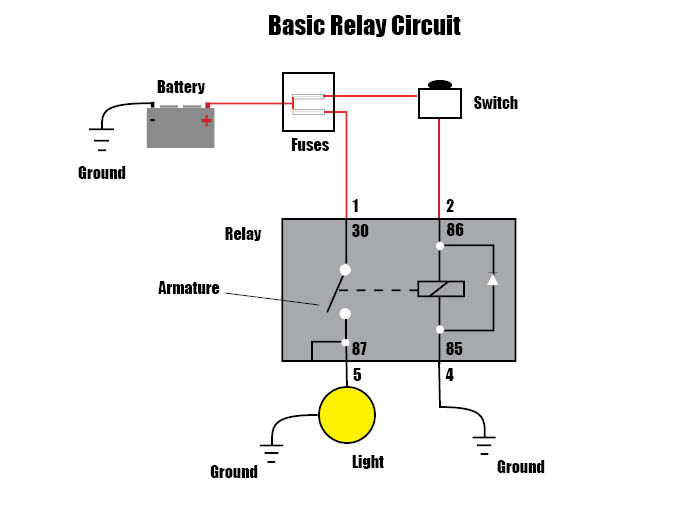
How to exam the blower motor relay?
Locate the blower motor fuse, likely a 30 or 40 amp, it may be marked on the fuse box comprehend or in the driver'due south transmission.

Apply a test light or voltmeter to check for power at the blower motor fuse with ignition and blower motor on.
Fuse boxes contain lots of relays, many are identical and can exist interchanged. A fast way to eliminate a faulty relay is to bandy out an identical relay and test the blower motor, just be sure the relays are indeed identical.
Cheque out the inexpensive relay tester on the Auto electric tools page.
Another quick test is to mind for a click when the blower switch is turned on. Relays give off an audible click initially when powered upwards, the click is the electromagnetic arm activating.
Notwithstanding, hearing a click doesn't mean it's working correctly, it simply ways the circuits appear to be skillful.
Using a multimeter, examination for power at the fuse with ignition and blower motor gear up to on. If power is present, all is proficient with the relay.

If on the other hand, you accept no power at the relay, that suggests a error with the relay or the controller.
If swapping out the relay doesn't assist, go ahead and check for power and footing on the control side using the multimeter to help identify where the fault lies, on the load side of the control side.
A lack of power on the control side suggests a problem with a control module. Control modules are expensive and may require a software upload and calibration after installation. If you lot suspect a fault in the control side
Check out my favorite wiring repair tools on the Machine electrical tools page.

Source: https://rustyautos.com/car-heater-not-blowing-air/
Posted by: biasmustionown.blogspot.com
0 Response to "How Many Amps Draw On Blower Motor 2002 Mercury Sable Draw"
Post a Comment